
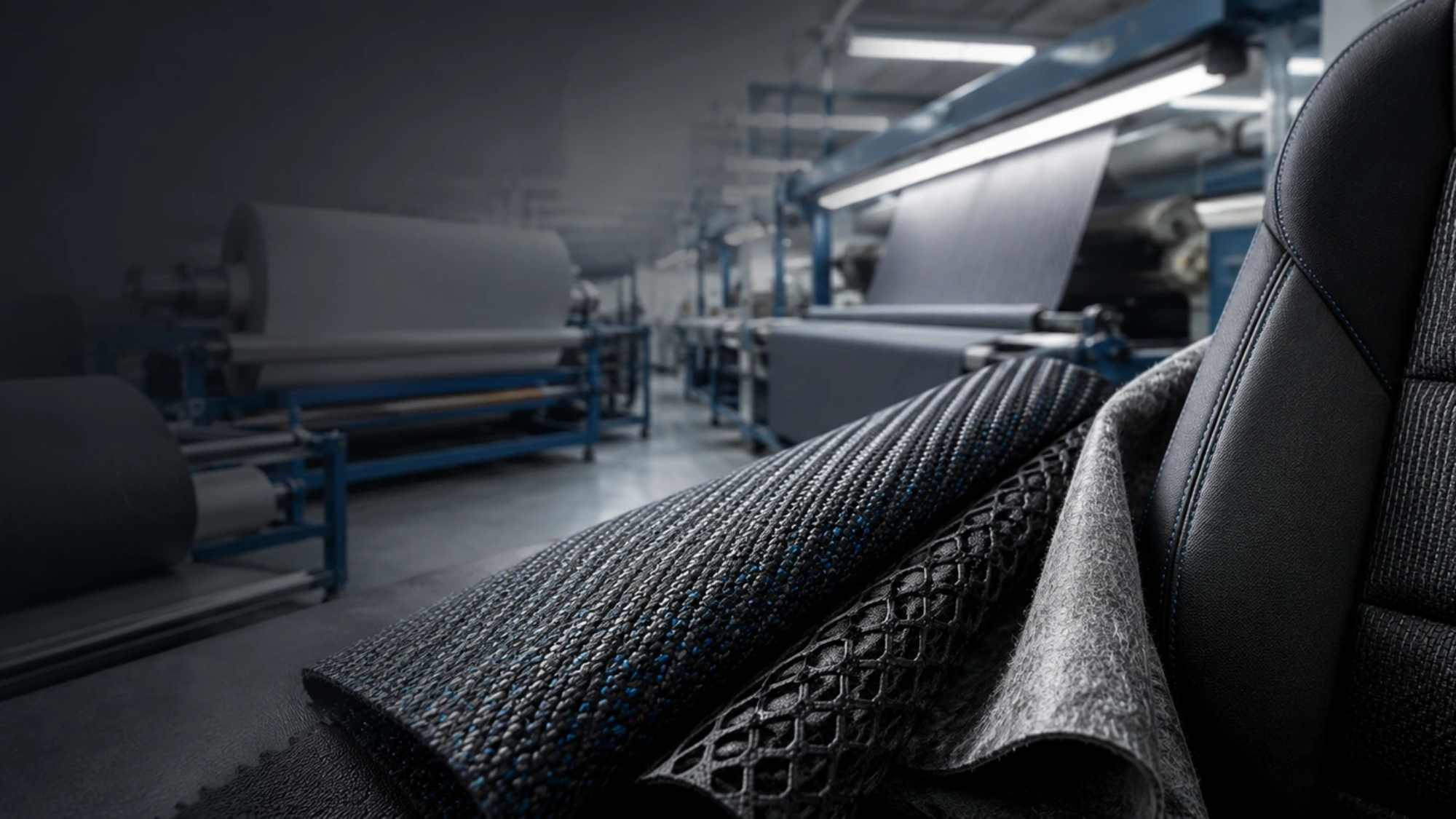
Automotive Textiles: Manufacturing
Automotive textiles have evolved far beyond decorative seat coverings and floor carpets. Modern vehicles use engineered textile materials across seating systems, headliners, door panels, trunk liners, acoustic insulation, filtration components, airbags, seat belts, and other interior and technical applications.
Each application introduces a different combination of performance requirements. A seat fabric must resist abrasion, preserve its appearance, remain comfortable, and meet flammability requirements. An acoustic nonwoven must absorb sound while remaining lightweight and formable. Interior trim materials must bond reliably to foams, plastics, and composite substrates while limiting odor, volatile organic compound emissions, and windshield fogging.
This creates a fundamental manufacturing challenge. Automotive textiles are expected to deliver safety, comfort, appearance, lightweight performance, durability, and environmental improvement at the same time.
Regulatory requirements make this balance even more demanding. In the United States, FMVSS No. 302 specifies burn-resistance requirements for materials used in vehicle occupant compartments. UNECE Regulation No. 118 addresses the burning behavior of interior materials used in certain vehicle categories. International standards also define methods for evaluating volatile organic compounds, odor, and fogging from vehicle interior materials. automotive textile manufacturing will therefore depend less on a single new fiber or fabric and more on the integration of material engineering, surface treatment, process control, testing, automation, and circular product design.
This article examines the main manufacturing challenges shaping the next generation of automotive textiles and the technologies being developed to address them.
Why Automotive Textiles Are Evolving Faster Than Ever
Vehicle interiors are becoming more technically complex. Manufacturers are under pressure to reduce vehicle weight, improve acoustic comfort, lower emissions from interior materials, use more recycled content, and maintain consistent appearance across increasingly complex surfaces.
At the same time, electrification is changing the acoustic environment inside vehicles. Removing or reducing conventional engine noise does not eliminate the need for acoustic management. It can make road, tire, wind, motor, and auxiliary-system noise more noticeable, increasing the importance of lightweight sound-absorbing textile structures.
Automotive suppliers are responding with porous fiber-based materials, molded nonwovens, multilayer constructions, natural-fiber composites, and recycled polyester systems designed to combine acoustic absorption, thermal insulation, formability, and lower weight. Current supplier developments include textile components with high recycled content and mono-material polyester constructions intended to simplify future recycling. oving one property can weaken another.
Reducing material weight may affect stiffness or acoustic performance. Increasing recycled fiber content may introduce variation in color, fiber length, contamination, or mechanical behavior. Adding coatings can improve stain resistance but complicate recyclability. Stronger bonding can improve component durability while making separation at the end of the vehicle’s life more difficult.
As a result, automotive textile manufacturing is increasingly an exercise in managing technical trade-offs rather than maximizing one isolated property.
The Performance Requirements of Next-Generation Automotive Textiles
Producing automotive textiles requires manufacturers to control multiple properties across the entire material and component system.
Abrasion Resistance and Long-Term Appearance
Vehicle textiles are exposed to repeated friction from passengers, clothing, luggage, child seats, cleaning equipment, and everyday use.
Seat fabrics, carpets, door-panel materials, and trunk liners must resist abrasion, pilling, snagging, seam damage, surface polishing, and permanent deformation. They must also retain their color and texture after prolonged exposure to sunlight, heat, rubbing, cleaning products, and changing humidity.
The challenge is not simply producing a fabric that performs well when new. Manufacturers must maintain performance after accelerated aging and repeated mechanical stress.
This becomes more difficult when recycled fibers, natural fibers, lightweight constructions, or unfamiliar polymer combinations are introduced. Material variation that may be acceptable in conventional textiles can create visible or functional inconsistencies in automotive production.
Research into automotive knitted fabrics demonstrates the need to balance mechanical durability, comfort, surface structure, and material construction rather than treating these characteristics independently. lity and Safety Compliance
Automotive interior materials must meet defined fire-performance requirements.
FMVSS No. 302 specifies burn-resistance requirements for materials used in the occupant compartments of passenger cars, multipurpose passenger vehicles, trucks, and buses. UNECE Regulation No. 118 covers aspects including ignitability, burning rate, and melting behavior for materials used in specified vehicle categories. rers, the difficulty is achieving compliant fire performance without creating additional problems.
Flame-retardant chemistry can affect odor, emissions, color, hand feel, bonding, processing behavior, recyclability, and cost. A material may perform differently after lamination, molding, adhesive application, or combination with foam and backing layers.
Testing only the visible textile layer may therefore provide an incomplete picture. Manufacturers must evaluate the finished construction under the applicable specification and production conditions.
Process consistency is also critical. A recent vehicle recall involving an interior sunshade showed that inconsistent material performance against FMVSS No. 302 can create a regulatory and safety issue even when the affected component appears relatively minor. Air Quality, Odor, and Fogging
Automotive textiles operate in a confined cabin that can reach elevated temperatures when a vehicle is parked in sunlight.
Under these conditions, textiles, adhesives, coatings, foams, synthetic leather, and polymeric backing materials may release volatile or semi-volatile compounds. Some compounds can contribute to odor, while others may condense on glass surfaces and create fogging.
ISO 12219-1 defines a whole-vehicle chamber method for determining volatile organic compounds and carbonyl compounds in cabin interiors under ambient, parking, and simulated driving conditions. ISO 12219-9 covers emissions from individual vehicle interior parts, while ISO 12219-7 provides a standardized process for evaluating odor. separate manufacturing concern. ISO 6452 provides a method for evaluating fogging characteristics of coated fabrics and other trim materials. ISO 12219-12:2025 specifically addresses fogging tests for PVC and polyurethane textiles used in vehicle interiors. is that emissions originate from the complete material stack, not necessarily from the textile face alone.
A fabric with acceptable emission performance may fail after it is combined with an adhesive, foam, backing, coating, or plastic substrate. Manufacturers must therefore consider raw materials, storage, curing conditions, lamination temperatures, adhesive quantity, packaging, and component aging.
Acoustic and Thermal Performance
Automotive textiles play an important role in managing noise and temperature inside vehicles.
Needle-punched felts, fiber-based absorbers, carpet systems, dash insulators, headliners, wheelhouse liners, underbody components, and trunk materials can be engineered to absorb sound or reduce sound transmission.
The manufacturing difficulty lies in controlling fiber composition, porosity, density, thickness, airflow resistance, compression, and component geometry. These variables influence acoustic performance, but they also affect weight, stiffness, moldability, and cost.
Increasing density can improve performance in some frequency ranges but adds mass. Reducing thickness saves space but may weaken absorption. Natural and recycled fibers can improve environmental performance, but material variability must be controlled.
Current automotive supplier technologies demonstrate how fiber mixtures, local density adjustment, recycled content, and molded textile structures can be used to tailor acoustic and structural behavior. These examples also show that acoustic performance cannot be separated from component design and manufacturing method. ghting and Structural Performance
Reducing vehicle mass remains an important engineering objective because every component contributes to total vehicle weight.
Textiles can replace heavier molded plastics, foams, or multilayer systems in selected applications. Fiber-based components can also combine several functions, including acoustic absorption, thermal insulation, surface appearance, impact cushioning, and structural support.
However, lightweighting does not automatically produce a better component.
A lighter automotive textile must still survive molding, trimming, handling, assembly, transport, and long-term use. It must maintain dimensional stability and avoid warping, delamination, wrinkling, edge fraying, or inconsistent compression.
The practical target is therefore functional integration: reducing mass and part complexity without transferring risk to quality, safety, or durability.
Bonding and Multimaterial Integration
Automotive interior components frequently combine textiles with polypropylene, polyurethane foam, adhesives, films, synthetic leather, natural-fiber composites, and molded polymer substrates.
These materials do not always bond easily. Low-surface-energy polymers such as polypropylene can create weak or inconsistent adhesive interfaces. Contamination, release agents, storage conditions, surface aging, and variable adhesive application can further reduce bond reliability.
Bonding failures can appear as bubbling, peeling, edge lifting, delamination, or changes in surface appearance after heat and humidity exposure.
Manufacturers must therefore control both material compatibility and surface condition. This is one reason textile surface treatment is becoming increasingly relevant to automotive manufacturing.
Sustainability Is Becoming a Manufacturing Requirement
Sustainable automotive textiles are moving from isolated demonstration projects toward broader production requirements.
The shift is being driven by vehicle manufacturers’ environmental targets, material reporting requirements, waste-reduction objectives, customer expectations, and regulatory developments.
In June 2026, the Council of the European Union approved new rules intended to increase circularity throughout the vehicle lifecycle. The rules include phased targets for recycled plastic content in new vehicles and requirements intended to support reuse, recycling, and remanufacturing. e textile manufacturers, greater recycled content is only one part of the challenge.
A material containing recycled fibers may still be difficult to recycle if it combines polyester, polypropylene, polyurethane foam, thermoset adhesives, coatings, and incompatible backing layers.
Circular automotive textile design therefore requires attention to:
- Material compatibility
- Number of polymer types
- Ease of component separation
- Adhesive selection
- Coating chemistry
- Production-waste recovery
- Traceability of recycled feedstock
- Consistency of secondary raw materials
- End-of-life collection and processing routes
Mono-material systems are one possible response. For example, automotive suppliers have developed carpet and trunk components based largely or entirely on polyester, allowing manufacturing cut-offs to be recovered and potentially returned to fiber production. -material design is not automatically superior in every application. It must still meet requirements for safety, appearance, stiffness, acoustics, emissions, cost, and production speed.
The central manufacturing question is not simply, “Can recycled material be added?” It is, “Can the complete component deliver stable automotive performance while supporting a credible recovery pathway?”
Surface Engineering: The Hidden Technology Behind Automotive Textiles
Many automotive textile problems begin at the surface.
The bulk material determines properties such as strength, thickness, and basic structure. The surface controls how the textile interacts with liquids, coatings, adhesives, dyes, contaminants, foams, and polymer substrates.
Textile surface engineering can be used to modify:
- Wettability
- Surface energy
- Adhesion
- Stain behavior
- Coating uniformity
- Printability
- Friction
- Soil release
- Water repellency
- Interface compatibility
These properties are especially important in multilayer automotive components.
A surface treatment may improve adhesive spreading, reduce the need for aggressive primers, support a more uniform coating, or help a functional finish remain attached during aging.
The manufacturing risk is applying more chemistry than necessary. Heavy wet treatments can add drying requirements, water consumption, chemical handling, emissions, weight, and process variability.
Future automotive textile production will increasingly require precise surface modification. The goal will be to change the interface where performance is needed without unnecessarily altering the complete material.
The Role of Textile Plasma Technology in Automotive Manufacturing
Textile plasma technology is one potential method for modifying automotive textile surfaces.
Plasma treatment uses ionized gas to clean, activate, functionalize, or modify the upper surface of a material. Depending on the process conditions, treatment can increase surface energy, introduce polar functional groups, alter surface roughness, and improve interaction with adhesives or coatings.
Because the modification is concentrated near the surface, plasma can change interfacial behavior while largely preserving the bulk structure of the textile.
Research involving polypropylene fabrics has reported improved adhesion between plasma-treated textile surfaces and polyurethane coatings. Other research comparing plasma, flame treatment, and primer coating examined bonding between polypropylene components and polyurethane artificial-leather fabrics used in automotive-type constructions. omotive textile applications include:
- Pretreatment before lamination
- Improved bonding between textiles and low-surface-energy plastics
- Surface activation before coating
- Improved coating uniformity
- Treatment before printing or functional finishing
- Reduced dependence on selected chemical primers
- Surface cleaning before adhesive application
Plasma treatment should not be presented as a universal replacement for conventional finishing or bonding processes.
Its effectiveness depends on the substrate, textile structure, gas chemistry, treatment power, treatment speed, distance from the plasma source, surface contamination, storage time after treatment, and the adhesive or coating applied afterward.
Surface activation can also age over time. A successful laboratory treatment does not guarantee stable industrial performance unless the process is integrated with controlled handling, inline monitoring, and suitable downstream application.
The strongest manufacturing case for plasma is therefore targeted process improvement.
A pilot should compare treated and untreated materials using relevant measures such as surface energy, peel strength, coating adhesion, aging resistance, heat and humidity performance, emissions, cycle time, energy use, and total process cost.
Manufacturing Innovation and the Future of Automotive Textile Production
The next generation of automotive textiles will require more precise manufacturing control.
Many defects originate from small variations in raw materials or processing conditions. Fiber distribution, yarn tension, coating weight, adhesive application, lamination temperature, molding pressure, cooling time, trimming accuracy, and storage conditions can all affect final component performance.
Traditional end-of-line inspection may identify a rejected component, but it does not necessarily reveal why the defect occurred.
Data-driven automotive textile manufacturing can improve this situation by connecting process parameters with quality results.
Potential applications include:
- Inline camera inspection for surface defects
- Automated monitoring of coating and adhesive application
- Digital control of temperature, pressure, and line speed
- Traceability of material batches and recycled content
- Statistical monitoring of production variation
- Predictive maintenance for textile and finishing equipment
- Automated detection of color, texture, wrinkles, and contamination
- Digital recording of test and compliance data
European textile-sector planning documents identify automation, digital production, traceability, and resource-efficient manufacturing as important development priorities for the industry. e suppliers, the practical objective is not digitalization for its own sake. Technology must reduce scrap, prevent quality escapes, shorten root-cause analysis, or improve process repeatability.
A poorly controlled automated process can produce defective components faster. Digital manufacturing creates value only when measurements are connected to clear process limits and corrective actions.
What the Next Decade Holds for Automotive Textiles
Several developments are likely to shape automotive textile manufacturing:
- Greater use of recycled polyester and recovered textile fibers
- Increased development of mono-material or material-compatible components
- Stronger requirements for VOC, odor, and fogging control
- More lightweight textile acoustic systems for electric vehicles
- Wider use of natural-fiber and hybrid fiber composites
- Increased recovery of production cut-offs
- More precise adhesive and coating application
- Greater use of inline quality inspection
- Improved material and process traceability
- More surface activation before bonding and coating
- Continued evaluation of plasma-assisted textile processing
- Greater integration of textiles with sensors, lighting, heating, and interactive interior surfaces
The central challenge will remain integration.
A future automotive textile must not only be recyclable, lightweight, or visually attractive. It must satisfy the complete component specification and remain manufacturable at automotive production volumes.
The technologies most likely to succeed will be those that improve several outcomes simultaneously, such as reducing weight while improving acoustics, increasing recycled content without weakening consistency, or improving adhesion while reducing primer use.
Conclusion
Automotive textiles are becoming engineered components rather than passive interior coverings.
They contribute to occupant safety, acoustic comfort, thermal management, interior appearance, air quality, lightweighting, and material efficiency. This expanded role creates stricter manufacturing requirements and more complex interactions between fibers, coatings, adhesives, foams, and polymer substrates.
The industry must solve several problems at the same time:
- Maintain durability and appearance
- Meet flammability requirements
- Control VOC emissions, odor, and fogging
- Reduce component weight
- Improve acoustic performance
- Increase recycled content
- Simplify future recycling
- Maintain reliable bonding
- Reduce production waste
- Improve process consistency
Surface engineering will be an important part of this transition because many manufacturing failures occur at the interface between different materials.
Within this area, textile plasma technology offers a potential method for improving surface activation, coating compatibility, and bonding performance. Its value, however, must be demonstrated through controlled pilots and application-specific testing.
No single material or treatment will define the future of automotive textiles.
Progress will depend on combining material science, surface engineering, testing, automation, and circular design into manufacturing systems that produce stable, compliant, and economically viable components.
For automotive textile manufacturers, the competitive advantage will not come from adding more functions to a fabric. It will come from delivering the required functions consistently, with fewer resources, lower production risk, and a clearer pathway for material recovery.
Check Our Other Article :
A Complete Guide to Textile Finishing and the Rise of Eco-Friendly Surface Technologies